

Recycled and regrind pellets
Recycled pellets can make large-format printing far more economical, but they need tighter material control than many teams expect. For furniture, moulds and display work, the useful question is not whether recycled content can run, but how cleanly and consistently it can run on a pellet machine.
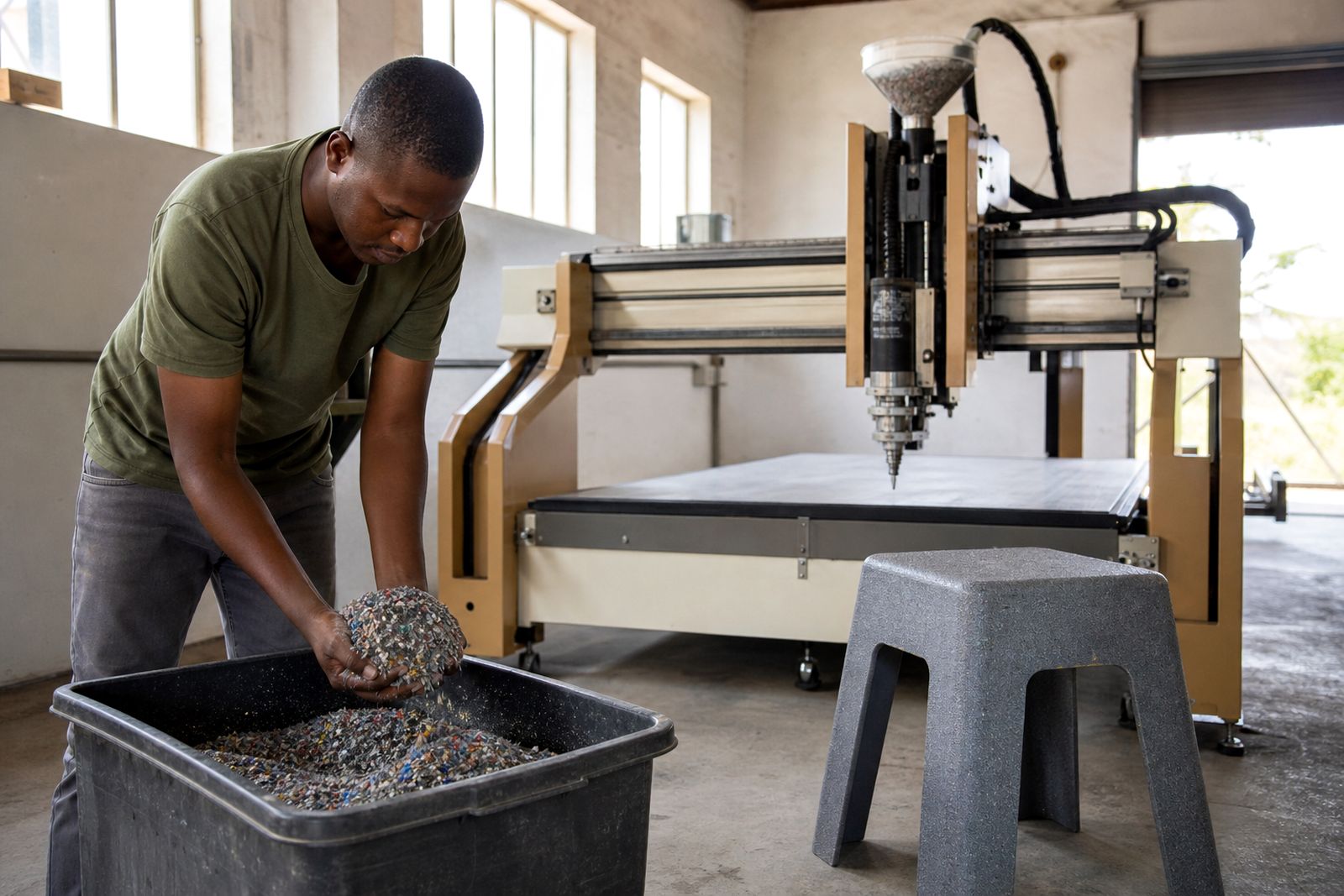
Recycled pellets can work well, if the feed stays consistent
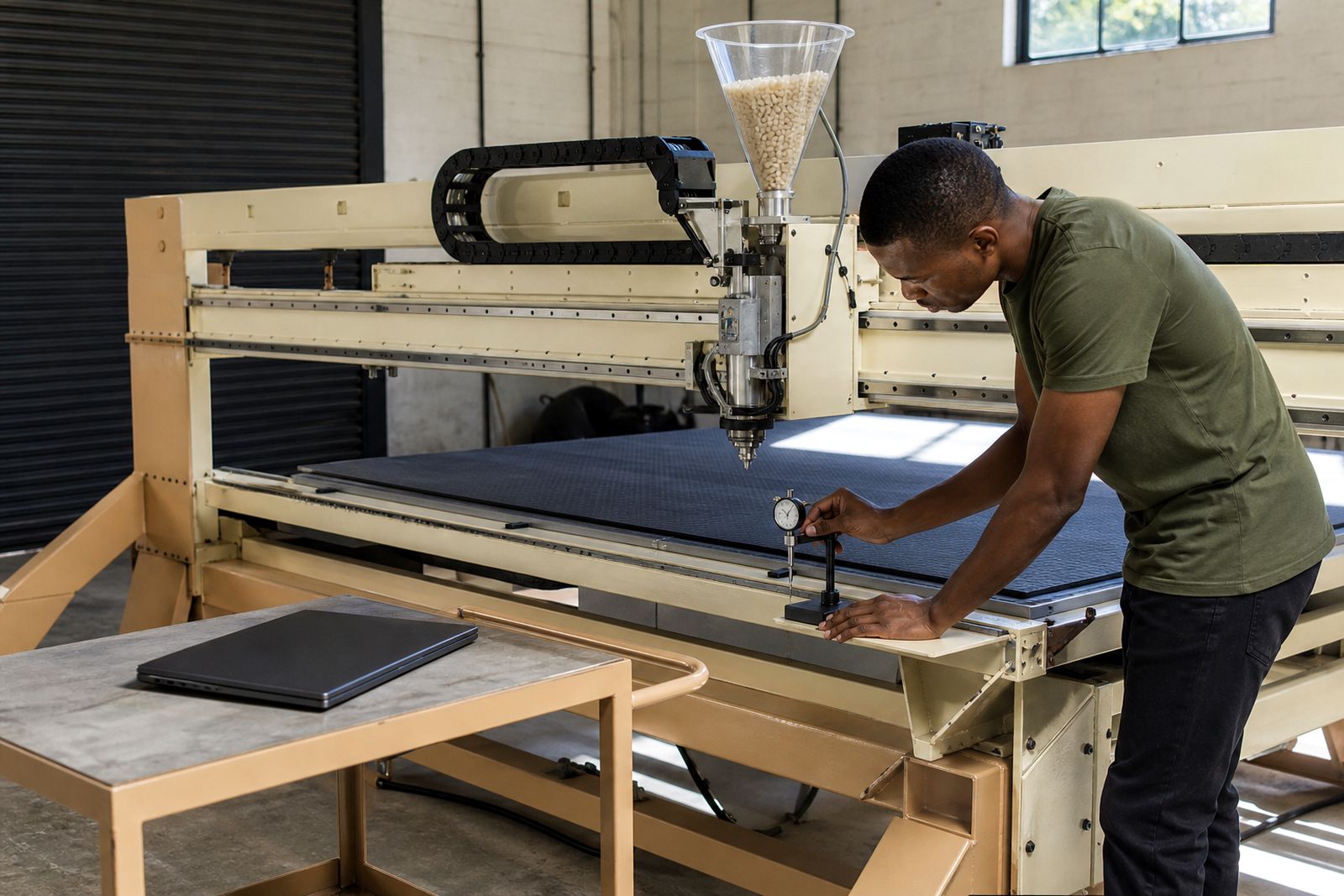
Pellet-fed printing is naturally better placed than filament systems to use recycled plastic, because the machine is built to process granules directly through a screw extruder. That opens the door to post-industrial pellets, controlled regrind and blended material streams for larger parts where material cost matters. It also means the machine will show every weakness in the feedstock, from moisture and dust to uneven pellet size.
For South African workshops making benches, planter shells, thermoforming moulds or composite tools, recycled content is often most practical where surface finish can be tuned after printing or where light sanding and coating are already part of the job. Parts that need long print runs and steady bead flow benefit most from a material stream that behaves the same from hopper to hopper, not one that changes from bag to bag.
The biggest mistake is assuming that recycled equals random. Good recycled pellets can print neatly and predictably, but only when the source, grading and drying routine are controlled properly.
The difference between recycled pellets and in-house regrind
Not all secondary material enters the workshop in the same condition. Purchased recycled pellets are usually washed, processed and pelletised by a specialist operation. In-house regrind is different. It may come from support walls, purge material, failed starts, offcuts or trimmed sections from finished parts. That can still be very useful, but it needs more checking before it goes back into production.
- Recycled pellets from an outside source are often more uniform in size and bulk density.
- In-house regrind may contain dust, flakes and irregular chips that do not feed as evenly as true pellets.
- Blended streams can work well where virgin pellets are used to steady melt flow and improve repeatability.
- Traceability matters more than people think, especially when several polymers are stored in the same shop.
If a workshop grinds its own scrap, the team should separate materials clearly at source. A little ABS mixed into a PP run, or damp PETG flakes poured into dry PLA pellets, can spoil hours of printing. Colour variation is also common with regrind, which may be acceptable for mould backers and hidden structures but not for visible furniture skins.
Material checks that matter before a long print
Large parts magnify small material faults. A short test piece may look passable while a full-sized chair shell or mould section reveals bubbling, voids, surging or weak layer fusion halfway through the job. Before committing to a long run, it helps to check the feed in a few plain, repeatable ways.
- Confirm the polymer family and keep each grade stored separately.
- Look for dust, fines and broken fragments at the bottom of the container.
- Check pellet size spread, because mixed sizes can affect hopper flow.
- Dry the material properly and keep it dry before feeding.
- Run a short extrusion test to watch bead stability and listen for popping.
- Inspect a sample wall for porosity, rough texture and uneven gloss.
Moisture is often the first problem in coastal regions, but Midrand workshops are not exempt just because the air feels drier. Material left open over a damp weekend can still take up enough moisture to show steam marks and rough beads on Monday morning. With fibre-filled grades the need for dryness is even stricter, and blocked nozzles become more likely if contamination is present.
How recycled content changes slicing and machine settings
Recycled and regrind feeds usually benefit from calmer, more forgiving settings than neat virgin material. The aim is steady extrusion, not chasing the highest possible throughput. If feed quality varies slightly, aggressive acceleration and sharp flow changes can exaggerate every inconsistency in the melt.
In practice, operators often reduce print speed a touch, avoid abrupt starts and stops, and choose bead widths that tolerate minor variation without leaving gaps. Nozzle temperature may need a small adjustment depending on the polymer and the amount of recycled content in the blend. Too cool, and the bead can drag or show poor bonding. Too hot, and the material may string, sag or smell harsher than usual.
Layer height and wall strategy matter too. For furniture and larger display elements, thicker walls and simpler toolpaths can hide minor cosmetic variation while keeping the structure stable. For moulds and tooling, the target is usually dimensional consistency and predictable machining allowance after printing, so a workshop may print slightly heavier walls and finish the critical faces later. It sounds basic but this is where many jobs are won or lost.
A South African workshop example
A factory between Johannesburg and Pretoria needed to produce oversized planter forms and seating shells for a retail fit-out programme. The parts were too large and too material-hungry for filament printing to make sense, so the team moved to a pellet process and tested a recycled blend based on a common commodity polymer. The first runs looked acceptable at the start, then bead width began to wander on longer sections.
The issue was not the printer. The feedstock contained too many fines, and the drying routine was inconsistent across containers. Once the workshop screened out loose dust, dried each batch properly and blended the recycled stream with a controlled portion of virgin pellets, the flow settled down. Surface quality improved, nozzle cleaning intervals stretched out and the operators could tune the slicing around a more predictable melt.
That shop did not chase maximum recycled content on every part. Visible pieces used a more controlled blend, while hidden structural sections and trial moulds carried a higher recycled ratio. That kind of split approach is often more practical than insisting every job use the same recipe.
Where recycled pellets fit best
Recycled material is usually strongest where the job rewards volume, low waste and sensible post-processing. It may be less suitable for parts that demand a flawless cosmetic skin straight off the machine or for applications where the material history is uncertain. Matching the feed to the part is the sensible route.
- Furniture shells where sanding, coating or lining is planned.
- Planters and display forms with thick walls and broad curves.
- Casting patterns and mould backers that will be machined or sealed.
- Composite layup tools where structure matters more than show finish.
- Prototype architecture pieces used to prove shape, scale and assembly.
At Pellet3D, we help workshops assess whether recycled pellets or regrind are suitable for the part, the screw extruder setup and the operator routine already on the floor. If you are weighing material options for a large-format build, you can send the job details through our contact form.
What our Pellet 3D Printing customers say
Verified Google reviews
Questions we get asked
Can recycled pellets be used for visible furniture parts?
Yes, provided the material stream is clean, dry and consistent. Many visible parts still need sanding, coating or other finishing, especially where colour and gloss must match across several prints.
Is regrind the same as recycled pellets?
No. Regrind often comes from in-house scrap and may be irregular in size, while recycled pellets have normally been processed and pelletised into a more uniform feed. Both can be useful, but they do not behave the same way in the hopper and extruder.
Which plastics are commonly considered for recycled pellet printing?
Workshops often look at recycled grades related to PLA, PETG, ABS and PP, depending on the part and service conditions. The right choice depends on stiffness, heat exposure, finish expectations and how stable the recycled stream is from batch to batch.
Also worth a look
Tell us about the job
Send sizes, materials and where you are through our contact form, and we will come back with the practical options.
Open the contact form