

Guides
This section gathers practical notes for workshops and factories moving into pellet-fed large-format 3D printing. It is written for teams comparing machine layouts, pellet materials, nozzle behaviour and day-to-day operating choices before a purchase or installation.
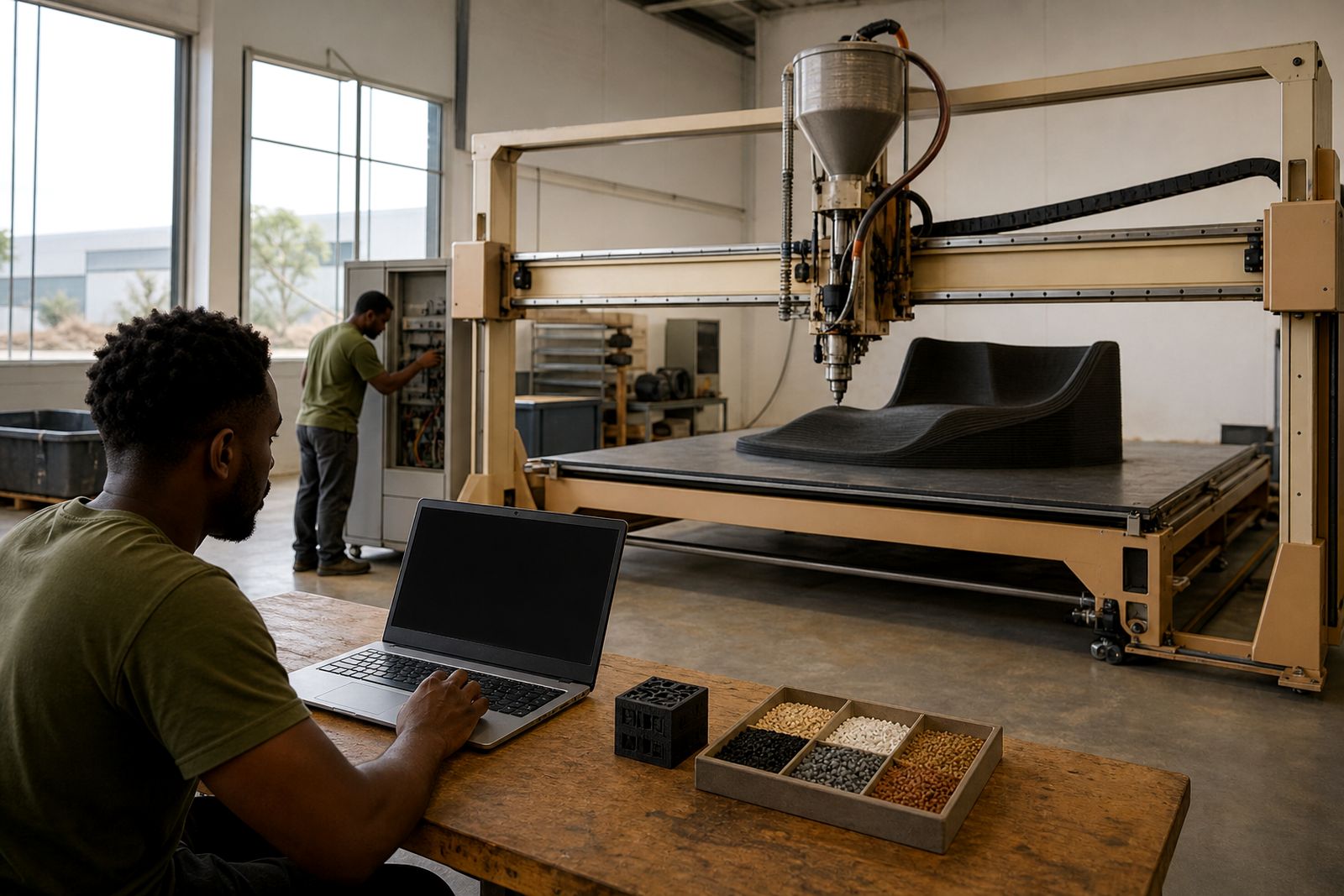
Where this guide section fits
Pellet-fed large-format printing asks different questions from small filament machines. The print head is heavier, pellets need to stay dry, nozzle sizes are larger, and the parts are often functional items such as seating, moulds, display components or production tools.
These guides are here to help you sort the important decisions in the right order. Rather than trying to cover every machine detail in one place, each page in this section focuses on a specific issue that affects output, material use and operator confidence on the floor.
If you are still at the early comparison stage, start with the guide on pellets versus filament for large parts, then move to slicing for large nozzles. After that, it usually makes sense to look at materials, machine layouts and support requirements as a set, not as isolated items.
The main choices most teams need to settle first
Before looking at a particular printer layout, it helps to pin down what you want to make and how those parts will be used. A chair shell, a planter, a mould plug and a thermoforming tool can all be printed from pellets, but they do not place the same demands on stiffness, finish, weight or post-processing.
- Part type: furniture, moulds, tooling, architectural pieces or display items.
- Material family: PLA, PETG, ABS, PP or fibre-filled grades.
- Surface expectation: rough production finish, machined finish or filled and painted finish.
- Throughput needs: occasional development work or regular batch production.
- Workshop conditions: space, power supply, pellet storage and ambient humidity.
- Operator capacity: whether your team is new to slicing and screw-extrusion setup.
Once those points are clear the machine discussion becomes much more practical, and you avoid buying around a spec sheet instead of buying around the actual job.
Reading the difference between pellets and filament
One of the most useful comparisons in this section looks at pellet-fed printing against filament-based printing for larger parts. That comparison matters because many South African workshops first approach additive manufacturing through desktop or mid-size filament equipment, then discover that furniture-scale parts and mould work behave quite differently.
- Pellets are generally better suited to large parts where material cost and output rate matter.
- Filament systems can be easier for small detailed parts, especially where fine features dominate.
- Pellet extrusion opens the door to a wider range of commodity and production polymers.
- Large pellet systems need more attention on drying, feed consistency and thermal stability.
- Post-processing expectations often matter more than headline print speed, thats where many buying decisions shift.
In practice, the right choice is not about one method replacing the other everywhere. It is about matching the production method to the size of the component, the resin family and the finish required after printing.
Large nozzles change slicing more than most people expect
Teams moving into pellet printing often assume that a slicer profile can be stretched from small-nozzle habits. It usually cannot. Large-nozzle work changes bead width, layer bonding, corner behaviour, overhang limits and cooling strategy, particularly on broad wall sections and tool shapes with long continuous paths.
The slicing guide in this section deals with those differences in a practical way. It looks at path planning, wall strategies, layer heights, extrusion consistency and the trade-off between appearance and output. For furniture and mould work, a stable print with predictable bead placement often matters more than chasing a cosmetic finish straight off the machine.
This is also where material choice starts to affect slicing decisions. A fibre-filled grade, for example, may call for a different approach from a standard unfilled polymer, both for flow behaviour and for the final surface after trimming or machining.
Material handling matters before the first layer starts
Pellet printing performance is not decided by the extruder alone. Moisture control, pellet cleanliness and feed stability have a direct effect on print quality, layer adhesion and consistency over long runs. In Gauteng this may seem manageable for much of the year, but coastal humidity can change how certain resins behave in storage and during printing.
That is why the material and pellet-handling pages sit close to these guides. They help teams understand when drying becomes important, which polymers are more sensitive, and how regrind or recycled pellets need a bit more attention before use.
For many workshops, this part of the process is where avoidable waste starts. A sound pellet routine often saves more trouble than chasing slicer tweaks after the machine has already started printing poorly.
Use these guides to narrow the right machine route
You do not need to read everything in one sitting. Most buyers and production teams can move through this section by following the job in front of them.
- If the question is process economics, start with pellets versus filament.
- If the concern is print quality with heavy bead sizes, go to slicing for large nozzles.
- If the challenge is resin behaviour, continue to the pellet materials pages.
- If your workshop needs help with setup, training or service planning, move on to the support section.
When the project scope is clearer, our contact form is the best place to outline the parts you want to produce, the materials you are considering and the workshop conditions on site. That makes it easier to discuss printer direction, operator training and the service level that suits your factory or studio.
Explore the range
What our Pellet 3D Printing customers say
Verified Google reviews
Questions we get asked
Are these guides meant for furniture only?
No. They also apply to moulds, tooling, display pieces and other large printed components where pellet extrusion makes sense.
Do the guides cover recycled or regrind pellets?
Yes. The material pages linked from this section look at recycled and regrind options, including the extra care often needed with feed consistency and drying.
Can these notes help before installation planning?
Yes. They are useful for narrowing machine type, material direction and operator needs before moving into installation, training and service discussions.
Tell us about the job
Send sizes, materials and where you are through our contact form, and we will come back with the practical options.
Open the contact form