

Pellets vs filament for large parts
When part size starts climbing, the feedstock choice changes the whole job. This guide compares pellet and filament printing for large parts so workshops can match output, finish and running cost to the work on hand.
Where the difference starts
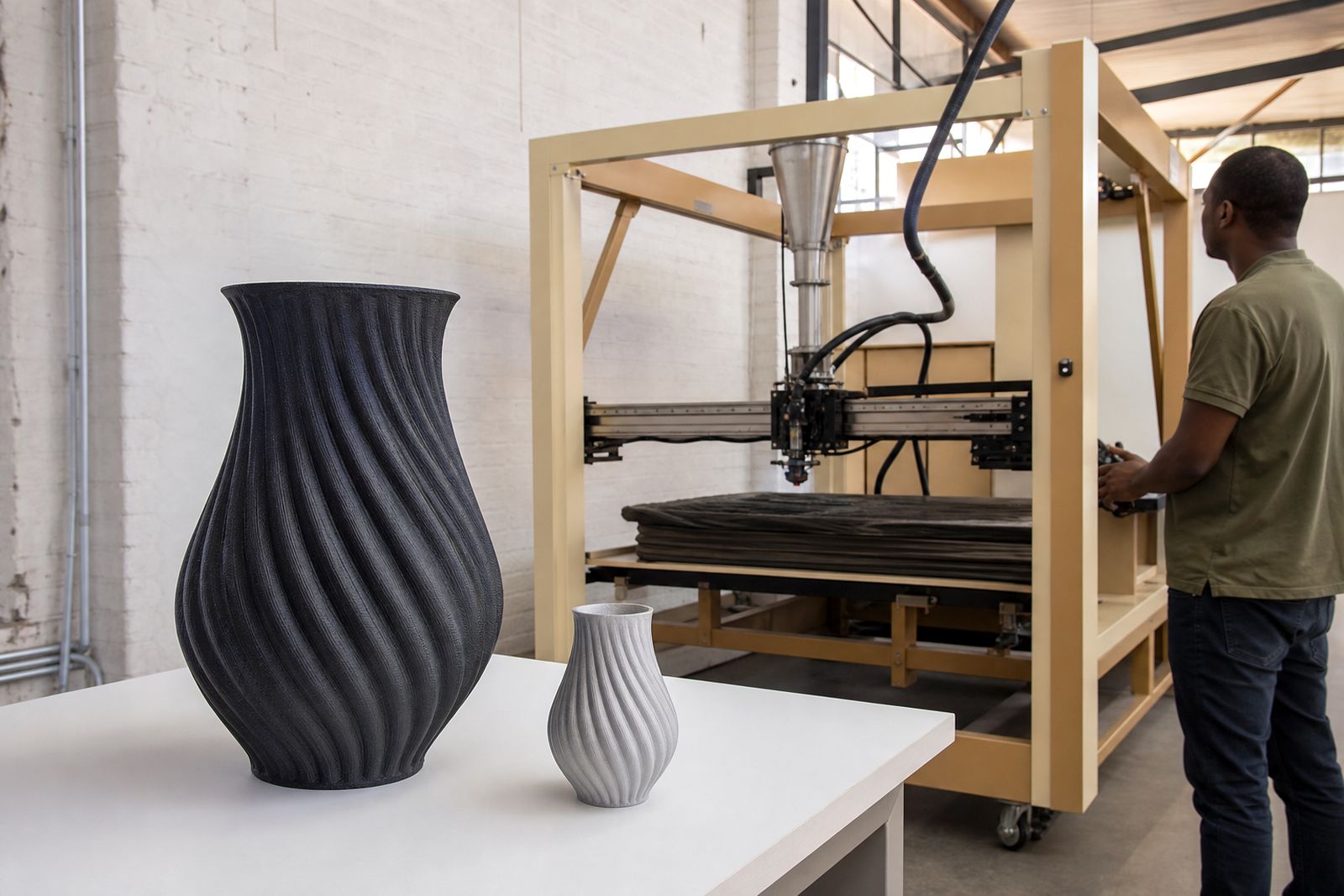
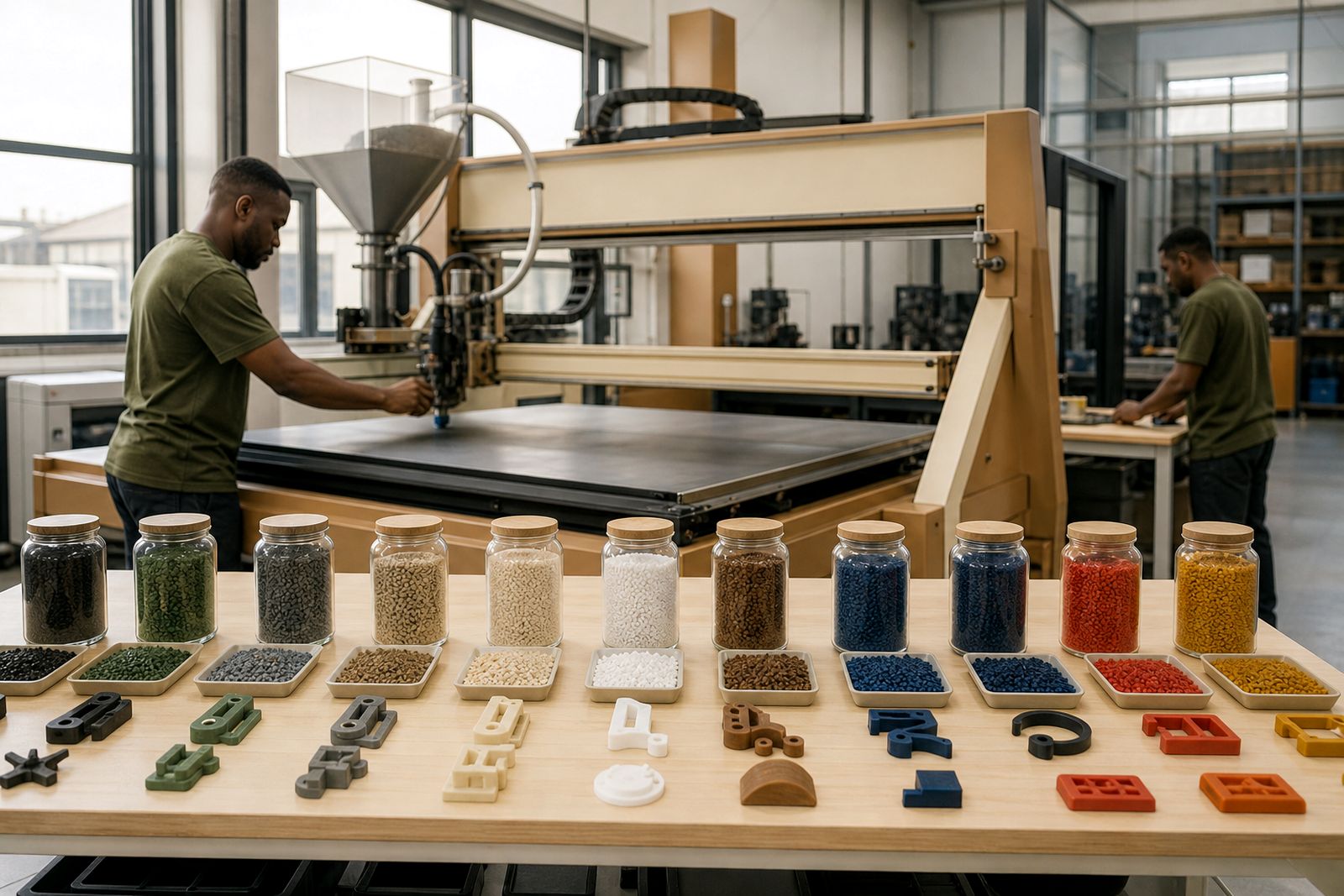
Filament systems melt a continuous strand and push it through a nozzle. Pellet systems feed plastic granules into a screw extruder, where the material is plasticised and deposited at far higher output rates. That one change affects cost per kilogram, bead size, machine layout, drying needs and the kind of parts that make financial sense.
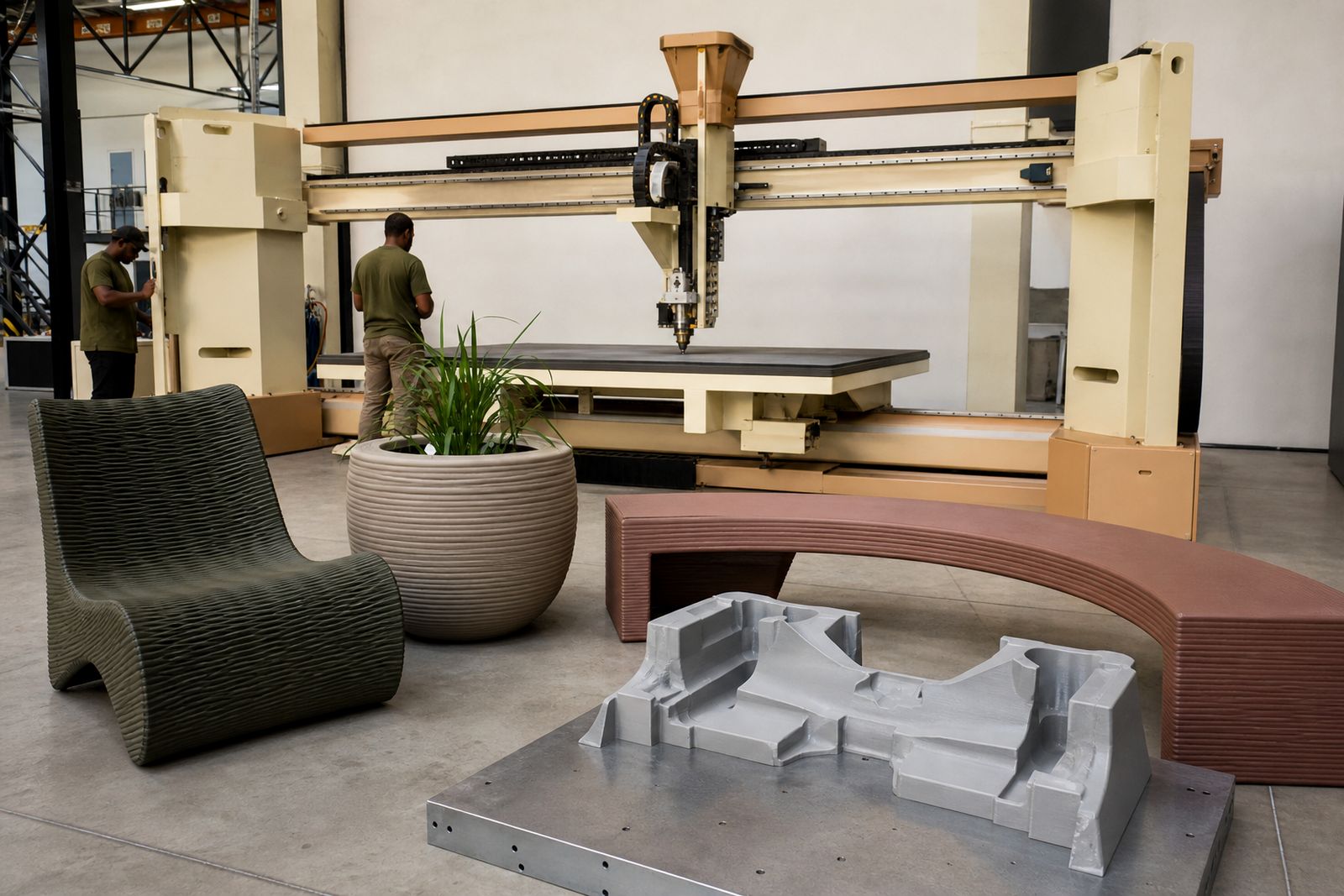
On small decorative items the gap may not matter much. On chairs, benches, moulds, display forms and large patterns, the gap becomes hard to ignore. A filament machine can produce a good part, but print time and material cost usually climb fast as the part gets bigger. Pellet printing was taken up for exactly this reason, large-format work needs material flow that suits larger beads and longer runs.
- Filament suits smaller parts, finer surface detail and lighter output requirements.
- Pellets suit large parts where material use and print duration drive the decision.
- Filament machines are often simpler to load and start.
- Pellet machines need more process control around drying, feed consistency and nozzle setup.
Material cost and wastage on real jobs
For large parts, feedstock cost is usually the first reason companies look at pellets. Granules are normally cheaper than the same polymer sold as filament, especially once part mass moves beyond a quick prototype. If a workshop is producing furniture shells, mould backs, layup tools or repeated display pieces, the Rand difference per job can become substantial.
Waste is another practical point. Pellets are available in production-grade materials that make more sense for industrial use, including PLA, PETG, ABS, PP and fibre-filled options. For some applications there is also scope to work with recycled or regrind streams where the process and part requirement allow it. That does not mean every recycled feed is ready to print, moisture content, particle size and contamination still need attention.
- Compare material cost by finished part mass, not by spool or bag price alone.
- Add support material, purge waste and failed print risk into the estimate.
- Check whether the part needs virgin material for appearance or mechanical consistency.
- Ask whether recycled or regrind pellets are realistic for the intended use.
Filament can still make sense where quantities are low, finishes matter more than throughput, or the part is not large enough to justify a pellet setup. But once the printed object is measured in furniture dimensions rather than hand-held dimensions, pellets often shift the costing in a meaningful way.
Print speed, bead size and machine time
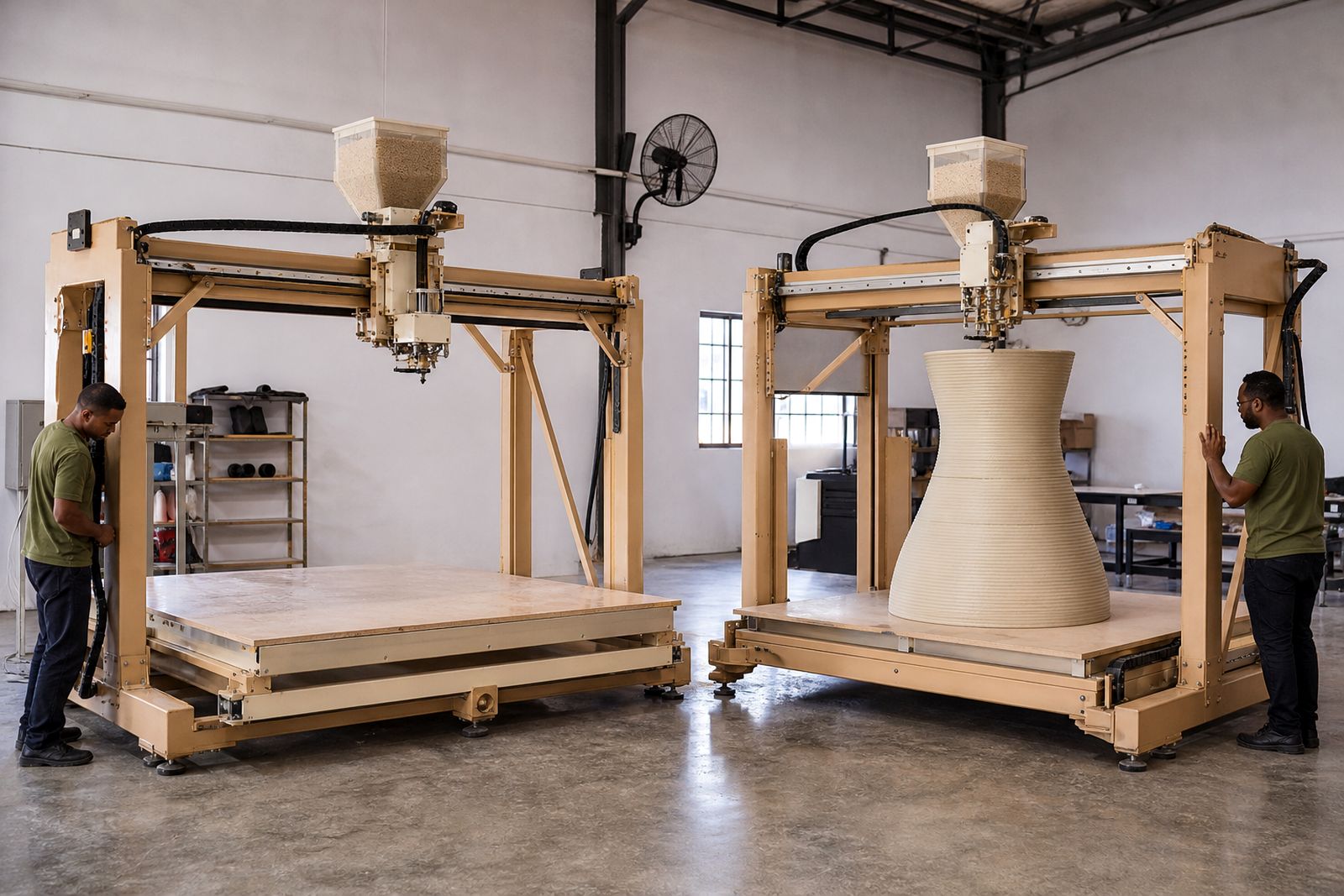
Pellet extrusion is usually chosen because it can move much more material through the nozzle. That shortens print time on bulky parts with thick walls or heavy infill. A planter, table base or mould body that would occupy a filament machine for a very long stretch can often be produced more sensibly on a pellet system.
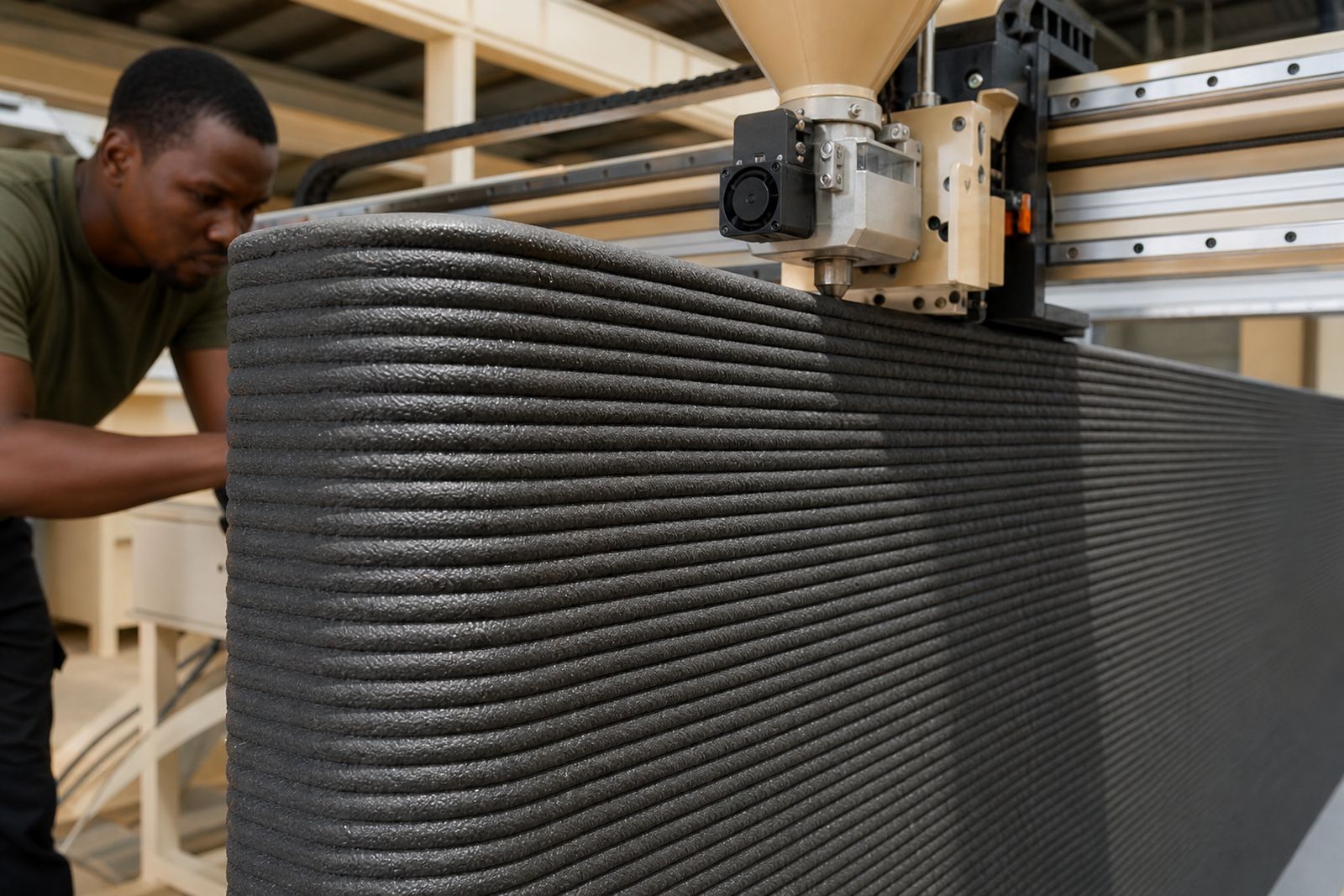
The trade-off is finish. Larger nozzles and higher flow rates lay down wider beads, so the printed surface has a stronger textured look. That can be perfectly acceptable for benches, structural display forms or moulds that will be machined or skimmed afterward. It may be less suitable where the final piece must leave the machine with a neat cosmetic face.
- Use pellets where shorter machine time matters more than a fine surface straight off the bed.
- Use filament where thin walls, small features and tighter visual detail lead the job.
- Plan for secondary finishing if the part needs a smoother show surface.
- Check slicing settings carefully, because large-nozzle work reacts strongly to layer height and bead overlap.
Machine time is not only about output speed. It also affects workshop scheduling. A large part that ties up equipment for too long can block more profitable work. That is one reason furniture makers and model shops often look closely at pellet-fed systems.
Surface finish, tolerances and post-processing
Filament usually has the edge on finer appearance and smaller detail. Narrower beads can hide stepping better and support a cleaner edge on compact features. If the part is a presentation model, a smaller fitting component or a detailed form that should need little hand finishing, filament stays useful.
Pellet printing becomes more attractive when the part is either functional, oversized, or expected to be trimmed, sanded, coated or machined after printing. Many mould and tooling jobs fall into this category. A thermoforming mould, casting pattern or composite tool often goes through secondary work anyway, so a faster print with a coarser bead can still be the right route.
Tolerance planning is important on both methods. Large prints move more with heat, and polymers like ABS or PP need sensible handling of shrinkage, bed adhesion and chamber conditions. Material choice matters here more than broad claims about one feed format being better than the other, some jobs fail from poor material matching rather than from the machine type itself.
Workshop checks before choosing pellets
A pellet printer is not just a bigger filament machine. The workshop should be ready for material handling, drying and operator setup. Moisture-sensitive materials can print badly if they are not dried properly, and inconsistent pellet feed can show up quickly in the bead. Space, extraction and access for installation also matter, especially in busy factories between production lines or in upper-floor studios with limited movement routes.
- Confirm floor space around the machine for loading, service access and safe operation.
- Check power supply and whether the site has stable provision for long print runs.
- Plan pellet storage that keeps material dry in Midrand summer storms and coastal humidity.
- Decide which materials the team will actually run in the first phase.
- Make sure operators understand large-nozzle slicing and purge routines.
- Review whether the final parts will be used as-printed or finished afterward.
If those basics are not in place, a filament machine may feel easier at first. But where production volume, part scale and feedstock cost are central, the extra discipline around pellets is usually justified.
A step-by-step way to decide
Start with the part, not the machine. List the largest items you need to print over a normal month and note whether they are furniture, moulds, patterns or display pieces. Then mark which jobs need a neat surface straight off the printer, which ones will be coated or machined, and which ones are simply too large to produce economically on filament.
Next, compare material families. PLA and PETG may suit visual parts and general prototyping. ABS or PP may suit tougher industrial use where chemistry and environment matter. Fibre-filled grades can add stiffness, but they also influence nozzle wear and processing. Drying, storage and slicing all need to match the chosen polymer, otherwise the comparison between pellets and filament gets distorted by setup mistakes.
- Write down the biggest part classes you expect to run every month.
- Separate appearance-led jobs from throughput-led jobs.
- Estimate post-processing time, not only print time.
- Check whether operators are ready for large-nozzle process control.
- Decide if the business needs one machine for many tasks, or a dedicated large-part tool.
Where the work centres on big forms and material spend matters, pellets usually win on economics and output. Where the work stays smaller and visual detail is the priority, filament often remains the simpler fit. If your team is weighing both routes for furniture, moulds or display pieces, send the project notes through our contact form and we can advise on machine class, materials and operator setup.
What our Pellet 3D Printing customers say
Verified Google reviews
Questions we get asked
Are pellet printers always cheaper to run than filament printers?
Not in every case. They are usually more economical on large parts because pellets often cost less per kilogram and the print finishes sooner, but drying, setup and finishing work still need to be counted.
Do pellet prints always look rougher than filament prints?
They often show a more visible bead because large-format pellet systems tend to use larger nozzles and higher flow. That finish is fine for many furniture and tooling jobs, and it can be sanded, coated or machined where needed.
Can the same materials be used in both pellet and filament printing?
Many common polymers overlap, including PLA, PETG, ABS and PP, but grade selection is not identical. Pellet printing also brings material handling points such as moisture control, particle consistency and fibre content into sharper focus.
Also worth a look
Tell us about the job
Send sizes, materials and where you are through our contact form, and we will come back with the practical options.
Open the contact form