

Display and architectural pieces
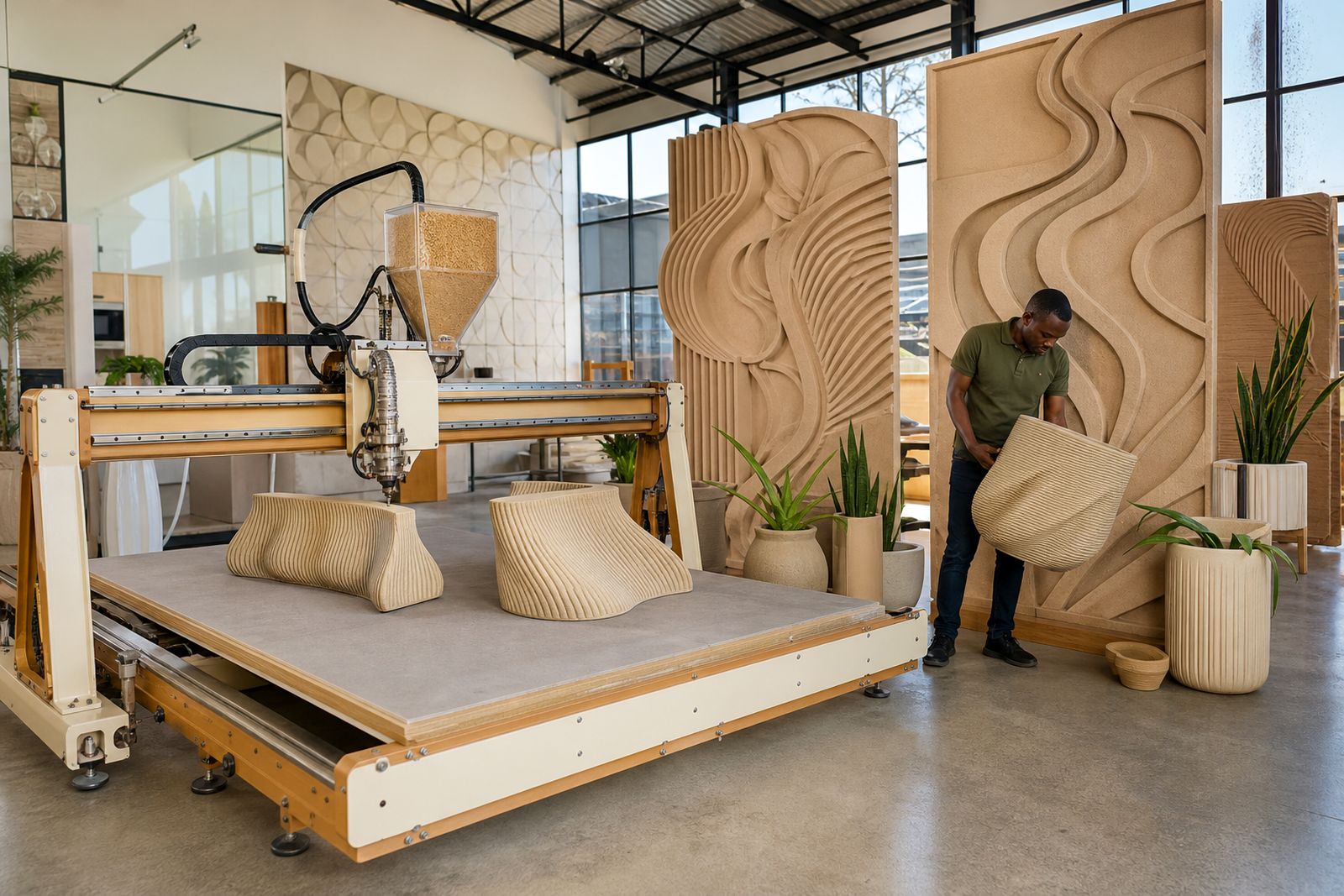
Large pellet 3D printing suits display work that needs scale, repeatability and material control without building every piece by hand. It is especially useful for shop fittings, decorative wall panels and planters where shape, weight and surface finish need careful balancing.
Where pellet printing fits on display jobs
Display and architectural pieces often sit in an awkward middle ground. They are too large for small-format printing, too changeable for moulded production, and too repetitive to keep making by hand. A pellet-fed large-format machine is useful here because it can build oversized forms directly from granules, letting a workshop move from sample to short production runs with less material handling.
For South African retail and built-environment work, the strongest candidates are pieces where the geometry carries the value. That includes freestanding product plinths, window-display forms, branded planters, reception features, ribbed wall sections and lightweight decorative shells fixed to a timber or steel backing frame. The process is less suited to tiny detail, jewellery-scale texture or glossy off-machine surfaces.
- Shop displays with repeated shapes in different sizes
- Wall panels that need controlled depth and pattern
- Planters with internal ribs and thick outer walls
- Event and exhibition features that travel between venues
- Architectural mock-ups, feature forms and facade samples
Because pellets feed through a screw extruder, material cost per kilogram is typically easier to manage than large filament builds. That matters when the part is physically big and the visible area is large enough that test sections are part of the job, not wasted effort.
Getting the shape right before the print starts
Large printed pieces work best when the form is drawn for the process rather than forced into it later. Wide nozzles leave a visible bead, so curves, ribs and faceted surfaces tend to print more cleanly than shallow ornamental detail. On a wall panel, for example, deep repeated relief usually reads better from two to five metres away than a fine pattern that disappears once painted.
Planters need different thinking. They must handle soil load, watering, drainage planning and lifting points, so wall thickness and base reinforcement matter more than a perfect skin. If the unit will sit in a mall entrance or office forecourt, the design should also account for scuffing, cleaning chemicals and direct sun. Dark colours can gain heat quickly, which affects both expansion and the feel of the surface.
- Break oversized pieces into sections with concealed joints
- Add fixing zones early instead of drilling blind later
- Use ribs and returns to stiffen broad flat faces
- Leave room for sanding, coating or skim finishing
- Plan transport dimensions before signing off geometry
Workshops that get the CAD stage right usually avoid the expensive part of these jobs, which is not the printing itself but the late changes after a sample has already shown where the weak areas are.
Material choices for indoor and outdoor pieces
Material selection should follow the actual site, not just the shape. Indoor shop displays often print well in PLA or PETG where the environment is more stable and the finish route may include primer and paint. Outdoor planters and architectural feature parts often push the job toward PETG, ABS, PP or fibre-filled grades depending on stiffness, weather exposure and fastening method.
Moisture control is a serious practical point. Pellets that have picked up moisture can leave a rougher surface, inconsistent flow and internal weakness, which becomes obvious on tall decorative parts. Drying and feeding equipment are not extras on this kind of work. They are part of keeping bead lines even and reducing defects over long prints.
In coastal areas, humidity changes how carefully the pellets need to be handled, and outdoor installations near the sea need thought on coatings and metal fixings. In Gauteng, UV and afternoon heat tend to be the bigger issue. A workshop in Midrand printing for projects across provinces will often test the same geometry in more than one material before final sign-off, just to make sure the finish route and mechanical behaviour line up.
Surface finish is a production step, not an afterthought
Clients usually notice finish first, especially on retail work. Large-nozzle printing can produce an attractive layered texture when that look suits the brief, but many display pieces need a calmer surface. That means the finishing method should be chosen at quoting stage and allowed for in the part design.
Some pieces are best left with a printed texture, particularly sculptural forms and back-of-house display components where function matters more than a showroom skin. Others need filling, sanding and a coating system. A deep groove pattern may hide layer lines well, while broad flat faces often show every inconsistency. This is where panel orientation and bead direction matter more than people expect.
- Printed texture can work well on planters and feature forms
- Primer and sanding help where branding or close viewing matters
- Joint lines should sit in shadow gaps or natural breaks
- Panels meant for paint need stable, repeatable bead deposition
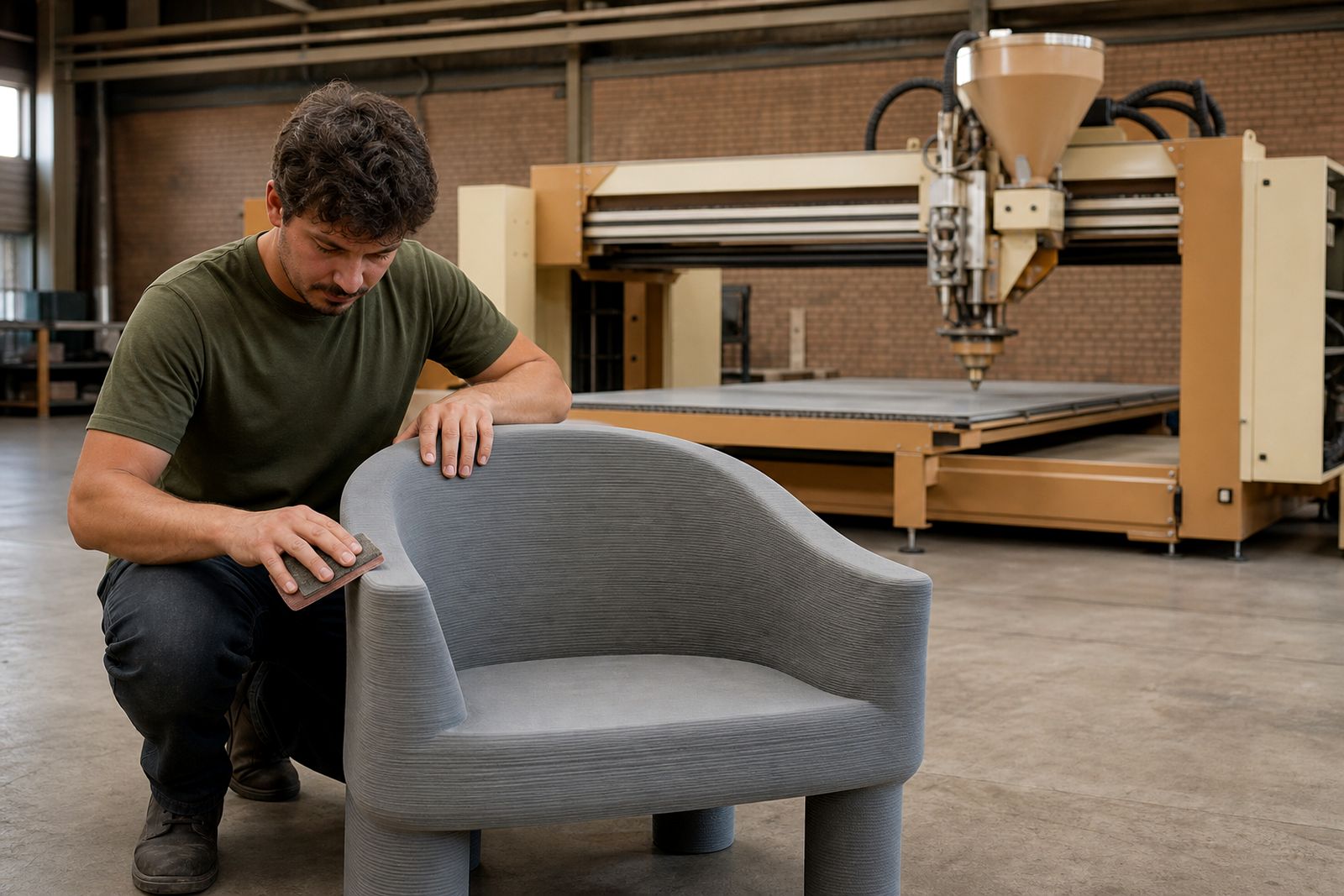
If the final piece will be touched often, such as a point-of-sale stand, edge radii and abrasion resistance deserve attention early. It saves awkward rework later, and the result feels less like a prototype.
A Midrand workshop example
One useful local pattern is a retail fit-out package made up of window-display forms, tall planters and a repeating wall feature for a new store rollout. In a Midrand workshop, the team first printed a reduced test section of the wall pattern to check bead spacing, corner definition and sanding effort. The original drawing had several shallow grooves that looked neat on screen but softened too much when scaled up with a large nozzle.
After revising the geometry, the workshop split the full parts into transportable sections and added hidden mechanical fixing points. The planters were printed with reinforced bases and internal features to support liners rather than relying on the outer shell alone. That kept the visible form lighter while giving installers a cleaner way to level the units on site.
The shop display elements used a different finish path. Visible customer-facing faces were prepared for coating, while internal support shells were left closer to as-printed condition. That balance reduced labour where no one would see it. The project moved better once the workshop treated printing, finishing and installation as one chain instead of three separate departments, and it showed on site.
Site planning and installation details that matter
Large printed architectural pieces usually need site coordination long before the truck leaves the workshop. Weight is only one part of it. Access through lifts, door widths, fixing substrates, fire requirements for interior public areas and municipal conditions on outdoor structures can all affect the print strategy.
Wall panels need a flat and stable backing condition. Printed parts can bridge small irregularities, but they should not be expected to hide poor substrate work. Freestanding display forms need a low centre of gravity or concealed ballast. Planters need drainage logic that suits the actual placement, not just the drawing set. A beautiful planter leaking onto polished tiles is still a failed installation.
- Confirm where joints can be hidden on site
- Check handling paths from truck to final position
- Match fixings to concrete, brick, drywall or steel supports
- Allow for thermal movement on sun-exposed installations
- Separate decorative shells from wet planting zones when needed
When these details are sorted early, pellet printing becomes a very practical route for pieces that would otherwise take long manual fabrication cycles and produce more waste than the job can justify.
What our Pellet 3D Printing customers say
Verified Google reviews
Questions we get asked
Are pellet-printed display pieces only suitable for prototypes?
No. They are often used for full-size display items and architectural features, especially where the shapes are large, repeated or revised between projects. The right finish route and fixing method are part of making them production-ready.
Can printed planters be used outdoors?
Yes, provided the material, wall design, drainage plan and coating system suit the site. Outdoor use in strong sun, coastal humidity or high-traffic public areas needs more careful material selection than an indoor decorative planter.
Do you help with material and machine setup for these parts?
Yes. We advise on printer size, pellets, drying, slicing choices, nozzle setup, operator training and site needs for workshops making display and architectural pieces. We do not design the furniture or display concept for clients.
Tell us about the job
Send sizes, materials and where you are through our contact form, and we will come back with the practical options.
Open the contact form