

Moulds and tooling
Pellet-fed large-format 3D printing suits mould work where size, material cost and iteration matter more than a polished cosmetic finish straight off the machine. For South African workshops making thermoforming moulds, foundry patterns or layup tools, the value is usually in getting a workable shape onto the floor with less waste and less manual pattern making.
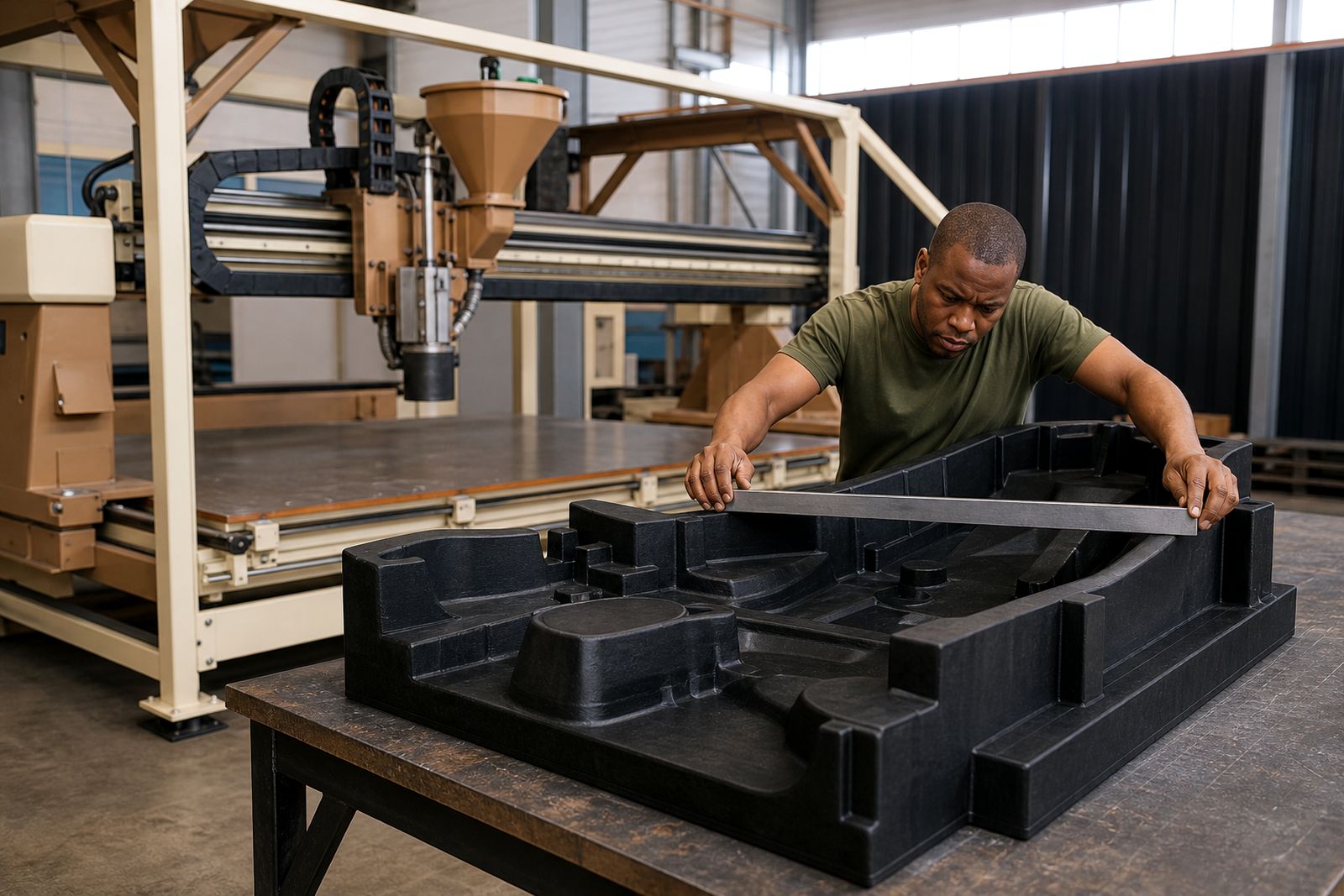
Where pellet printing fits in toolmaking
Not every tool belongs on a pellet printer. The method earns its place when the part is too large for ordinary filament equipment, when material use needs tighter control, or when a workshop wants to machine and seal a near-net shape instead of carving the full block from solid stock. A pellet system lays down plastic granules through a screw extruder, which makes large beads practical and keeps material cost in check on bigger jobs.
In local factories this tends to matter most on moulds and tooling that are bulky rather than fine-featured. A thermoforming mould for packaging development, a foundry pattern for a short production run, or a composite layup former for an oversize panel can all start as printed geometry and then move through normal workshop finishing steps.
- Thermoforming moulds for trial runs and low to medium production needs.
- Casting patterns where quick dimensional checks matter before machining aluminium or hardwood tooling.
- Layup tools and support formers for composite parts, trims and fairing pieces.
- Jigs and handling aids that need volume more than mirror-finish surfaces.
Thermoforming moulds need stiffness, sealing and airflow
Thermoforming is often the first area where large pellet printing makes immediate sense. The mould shape can be printed quickly, then machined where needed, sealed, coated and drilled for vacuum flow. The printed shell does not have to leave the machine as a finished production surface. What matters is enough wall thickness for stability, enough internal support to avoid sag, and sensible access for vacuum channels and trimming.
Material choice depends on forming temperature, sheet type and how many pulls the mould must handle. PLA can be useful for proving geometry or very light duty work, but workshops usually move to PETG, ABS, PP or fibre-filled grades where heat and durability matter more. The right pick depends on shop conditions, part size and whether the tool will stay in a warm area through summer.
- Build extra stock on the forming face if you plan to machine it true.
- Allow proper draft from the start rather than trying to sand it in later.
- Plan vacuum paths before slicing, not after printing.
- Seal the printed surface thoroughly so fine leaks do not spoil forming consistency.
On the Highveld a factory may work in fairly dry air, while a coastal shop has to think harder about moisture in pellets and coatings. That affects print quality and later finishing more than many first-time users expect.
Casting patterns and foundry work benefit from near-net shapes
Pattern making can absorb a surprising number of workshop hours, especially on larger forms with repeating contours. A pellet printer changes that by producing the bulk shape directly from CAD, leaving the pattern shop to focus on machining allowances, split lines, inserts and surface preparation. Instead of cutting away most of a board or block, the team starts much closer to the final profile.
For foundry patterns, dimensional planning still matters. Shrinkage allowance, draft, core print areas and handling points need to be set into the model before printing starts. The printed pattern then becomes a base for skim machining, filling and coating. That sequence is often more controlled than trying to hand-build large forms from timber sections, although some shops still combine both methods where it suits the job.
One Midrand workshop supporting plants in Gauteng and the North West used a printed pattern approach for a large short-run casting job after repeated changes made conventional pattern construction expensive. The team printed the main body in sections, bonded and trued the assembly, then machined the critical faces. The result was not magic, but it reduced wasted board material and let the workshop lock dimensions sooner than their old process.
Composite layup tools are won or lost in finishing
For composite moulds and layup formers, printing is only one stage. The tool has to hold shape under vacuum, support release systems and maintain a stable working face once sealed. Pellet printing is useful here because large forms can be built without the cost penalty that often comes with filament on the same scale, but the final result depends heavily on post-processing.
Most composite teams care about four things: stability, repeatability, workable surface quality and repairability. A printed tool can answer all four if the design includes proper ribs, enough machining stock and sensible segmentation for transport or replacement. Large single-piece ambition often sounds good on paper, then causes trouble at the machine and in the shop.
- Split oversized tools into sections where alignment can be controlled mechanically.
- Add flanges, location features and bonding faces into the model from the start.
- Choose bead direction with later machining and vacuum loading in mind.
- Expect coating and sanding cycles before the tool reaches production use.
Printer setup matters more than glossy brochures
Tooling parts ask a lot from the printer and the operator. Large-nozzle work, high bead flow and long run times make pellet condition, drying and feed stability important. Moisture in the granules can show up as poor bead consistency, weak surfaces or trapped porosity, and those faults become expensive once a tool reaches machining or sealing.
Slicing strategy also needs a different mindset from small decorative printing. You are balancing bead width, layer height, wall paths, internal structure and thermal behaviour on large masses of plastic. The target is not a pretty print sitting on a shelf. The target is a stable blank that machines cleanly and keeps its shape on the workshop floor.
Before installation, a factory should think about floor space, material handling, extraction, operator access and how printed sections will move to machining and finishing. That planning saves headaches later, and it stops the printer becoming an isolated machine that nobody can feed properly during a busy week.
What to settle before a tool goes to print
The strongest tooling jobs are the ones where design, printing and finishing are treated as one chain. If a mould face needs machining allowance, add it early. If a pattern will be split, model the join strategy early. If the tool will sit near ovens or heated forming lines, choose material with that reality in mind rather than hoping a cheaper resin will cope.
- Target use: prototype, bridge tooling or repeated production work.
- Material temperature demands during forming, casting or layup.
- Machining allowance on critical faces and edges.
- Section joins, alignment features and transport limits inside the factory.
- Sealing, coating and repair methods the workshop already knows well.
Pellet3D works with workshops and factories around South Africa on printer selection, materials, large-nozzle slicing, installation, operator training and service for this kind of work. If your team is weighing printed tooling against board machining or hand-built patterns, our contact form is the place to start that discussion.
What our Pellet 3D Printing customers say
Verified Google reviews
Questions we get asked
Can pellet-printed moulds be machined after printing?
Yes. Many tooling jobs are printed as near-net shapes and then machined on critical surfaces, edges and datum areas. That is often the most practical route for thermoforming moulds, casting patterns and composite tools.
Which materials are commonly used for printed tooling?
PLA may suit light trials, but workshops often move to PETG, ABS, PP or fibre-filled grades when heat, stiffness or durability matter more. The right choice depends on the process temperature, finishing method and expected tool life.
Do you design moulds for clients or run production printing?
No. Pellet3D supplies, installs and supports pellet-fed large-format 3D printers, and advises on materials, slicing, site needs, training and service. We do not design furniture for clients, sell filament printers or offer volume contract printing.
Tell us about the job
Send sizes, materials and where you are through our contact form, and we will come back with the practical options.
Open the contact form